A new article from our collaboration with the UFV is out in Nanoscale:
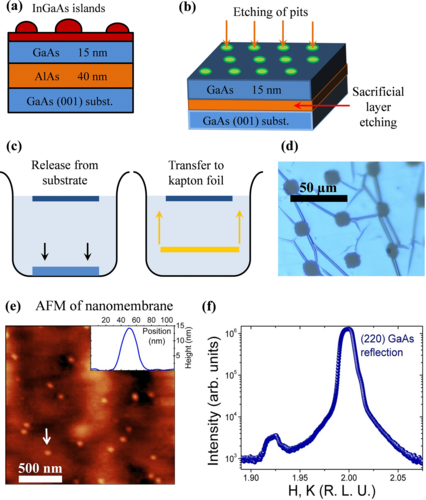
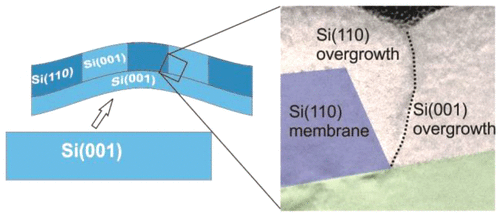
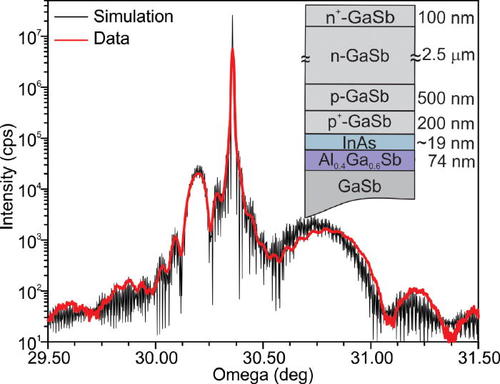
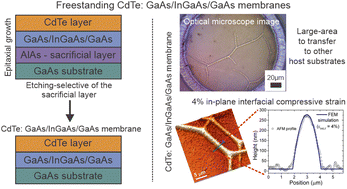 CdTe is a key binary compound for II-VI semiconductor systems since the precise control of its growth over different semiconductor materials of different orientations provides a general roadmap for telluride compounds, ranging from optically active layers to diluted magnetic semiconductors and topological insulators. The precise understanding of its epitaxy, film orientation and built-in strain is crucial for II-VI layer integration with commercial hosting substrates used for the latest semiconductor process nodes such as Si and GaAs. In this work, we show that it is feasible to use CdTe:GaAs/InGaAs/GaAs released membranes, yielding high-quality crystalline layers. A combination of Raman scattering and X-ray diffraction results provide a concise scenario of evolution along different growth stages. Surface roughness and contact potential are evaluated by atomic force and Kelvin-probe microscopy, respectively. The coexistence of faceting types (001) and (111) becomes clear using AFM and KPFM near the edge of a CdTe membrane. At such edges the local cleavage of the membrane is probed, exposing several layer steps and reflecting the growth history of CdTe. In this condition, KPFM clearly differentiates faceting (throughout contact potential difference) more accurately than height profiles, allowing a qualitative explanation of the nucleation evolution in our system. Finally, the occurrence of a 4% in-plane interfacial compressive strain is observed by nanomembrane release and modelling with finite element methods. The results showing the flexibility of high-quality CdTe layers here can improve optoelectronic integration of II-VI semiconductors.
Wesley Fiorio Inoch, Eduarda Policarpo, Misael Cesar Isaac Muniz, Angelo Malachias, Gilberto Rodrigues-Junior, Sukarno Olavo Ferreira, Christoph Deneke, Bráulio Soares Archanjo, Erika Peixoto Pimenta Peixoto Pimenta, Luciano Moura, Eduardo Nery Duarte Araujo and Leonarde do Nascimento N. Rodrigues
Nanoscale, 2025, 17, 15279 – 15288
DOI: https://doi.org/10.1039/D4NR05029K
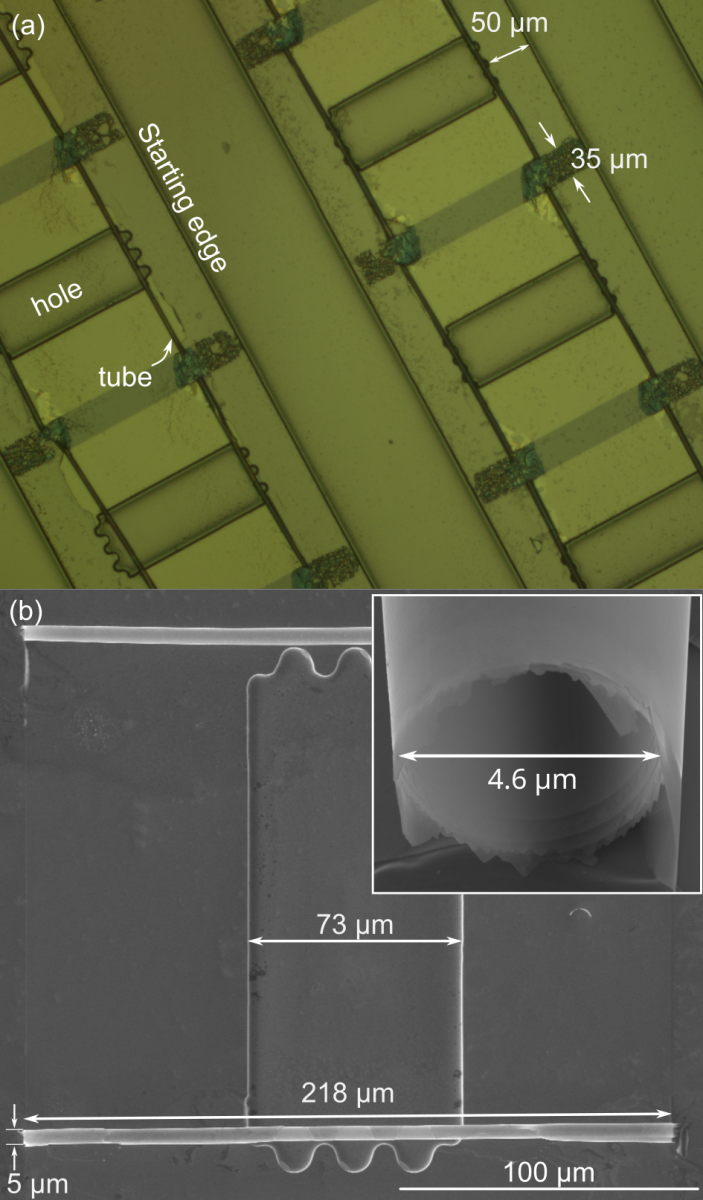
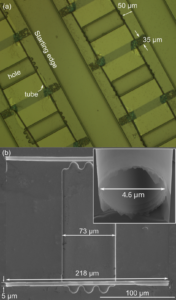 Our paper “Review: using rolled-up tubes for strain-tuning the optical properties of quantum emitters” is out.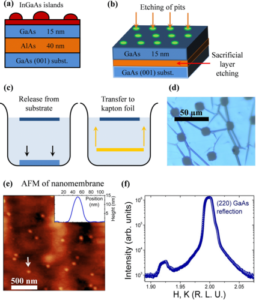
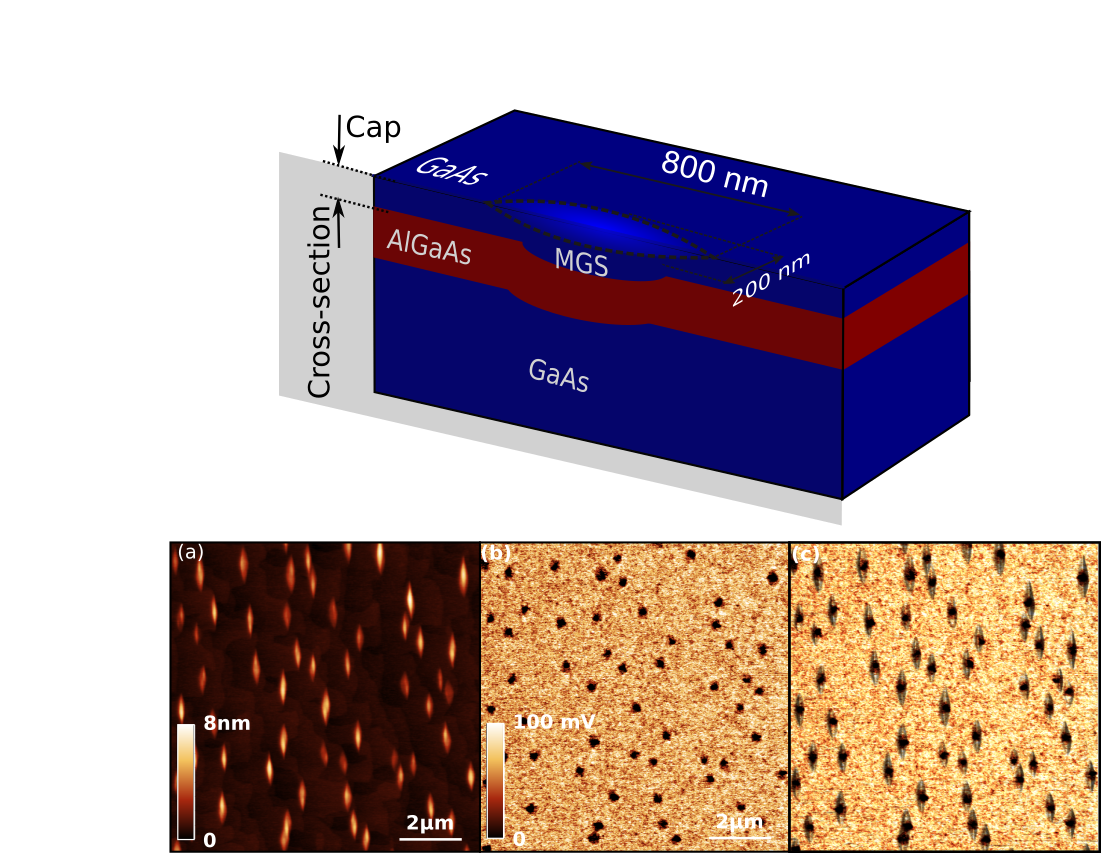
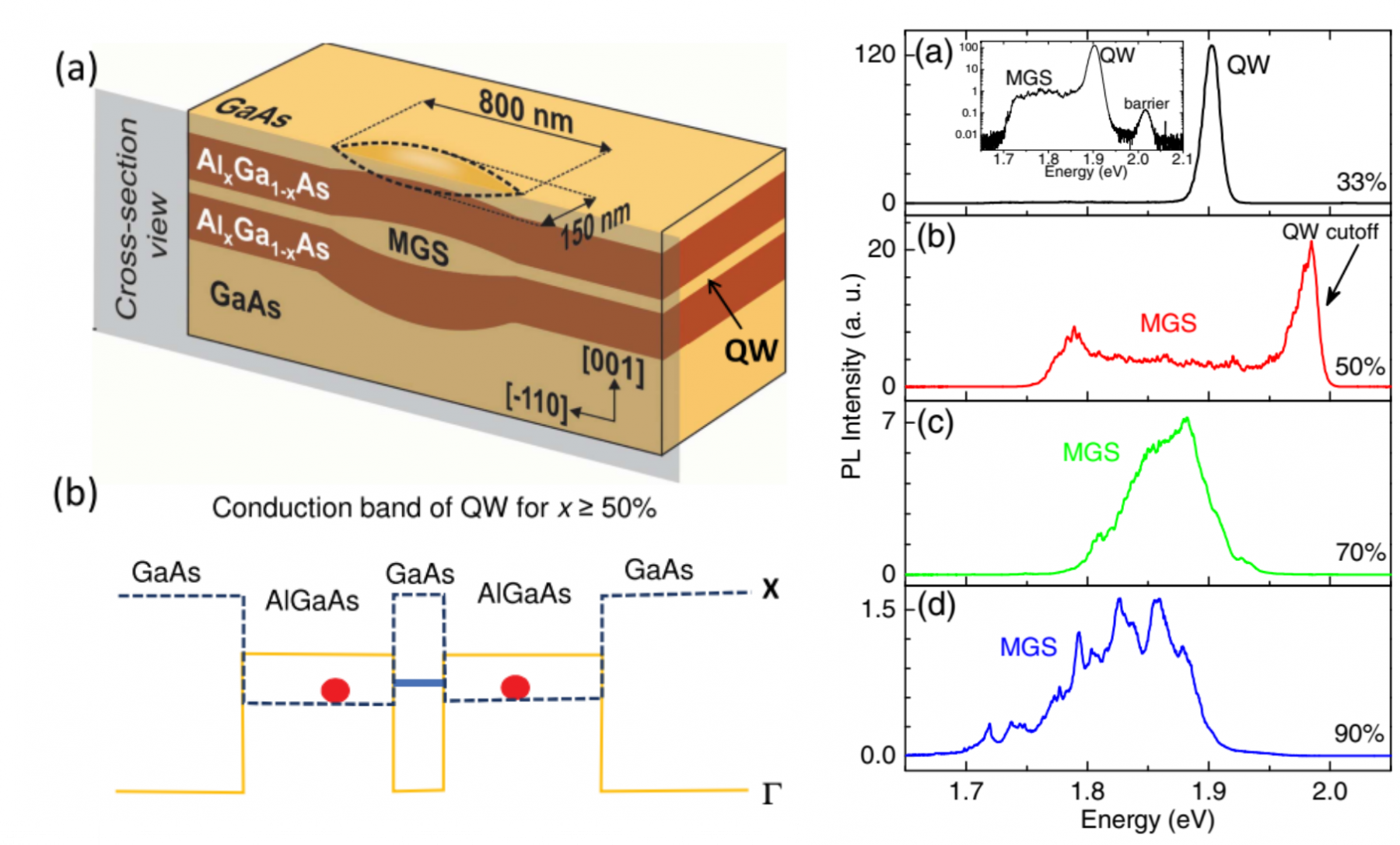
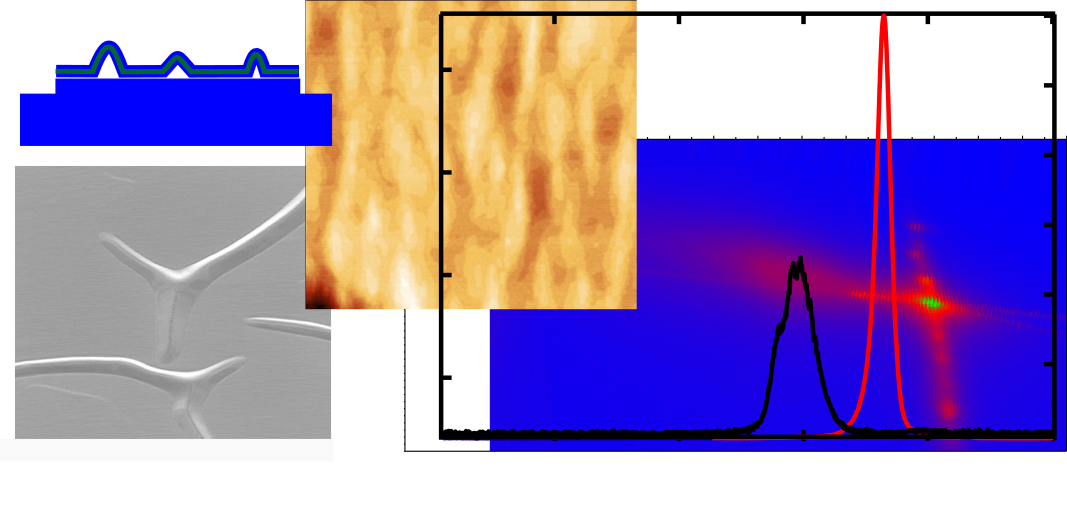
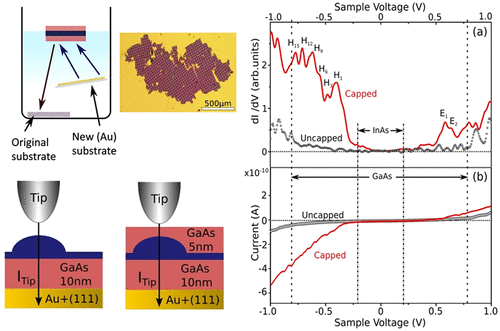
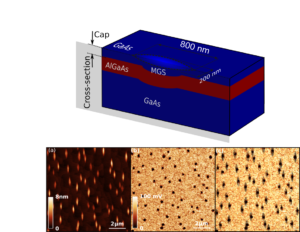 Unstrained GaAs quantum dots are promising candidates for quantum information devices due to their optical properties, but their electronic properties have remained relatively unexplored until now. In this work, we systematically investigate the electronic structure and natural charging of GaAs quantum dots at room temperature using Kelvin probe force microscopy (KPFM). We observe a clear electrical signal from these structures demonstrating a lower surface potential in the middle of the dot. We ascribe this to charge accumulation and confinement inside these structures. Our systematical investigation reveals that the change in surface potential is larger for a nominal dot filling of 2 nm and then starts to decrease for thicker GaAs layers. Using k · p calculation, we show that the confinement comes from the band bending due to the surface Fermi level pinning. We find a correlation between the calculated charge density and the KPFM signal indicating that k · p calculations could be used to estimate the KPFM signal for a given structure. Our results suggest that these self-assembled structures could be used to study physical phenomena connected to charged quantum dots like Coulomb blockade or Kondo effect.
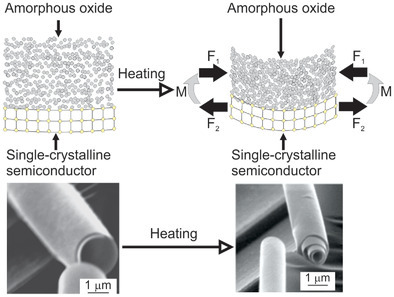
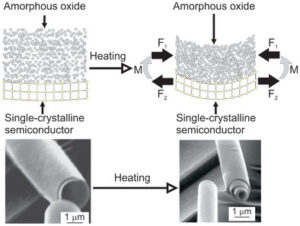 nanoscale assembly to access a broad range of 3D geometries and hybrid materials. An amorphous SrTiO3 layer on a Si:B/Si1−xGex:B heterostructure is reconfigured at the atomic scale upon heating, exhibiting a change in volume of ≈2% and accompanying biaxial stress. The Si:B/Si1−xGex:B bilayer is fabricated by molecular beam epitaxy, followed by sputter deposition of SrTiO3 at room temperature. The processes yield a hybrid oxide/semiconductor nanomembrane. Upon release from the substrate, the nanomembrane rolls up and has a curvature determined by the stress in the epitaxially grown Si:B/Si1−xGex:B heterostructure. Heating to 600 °C leads to a decrease of the radius of curvature consistent with the development of a large compressive biaxial stress during the reconfiguration of SrTiO3. The control of stresses via post-deposition processing provides a new route to the assembly of complex-oxide-based heterostructures in 3D geometry. The reconfiguration of metastable mechanical stressors enables i) synthesis of various types of strained superlattice structures that cannot be fabricated by direct growth and ii) technologies based on strain engineering of complex oxides via highly scalable lithographic processes and on large-area semiconductor substrates.
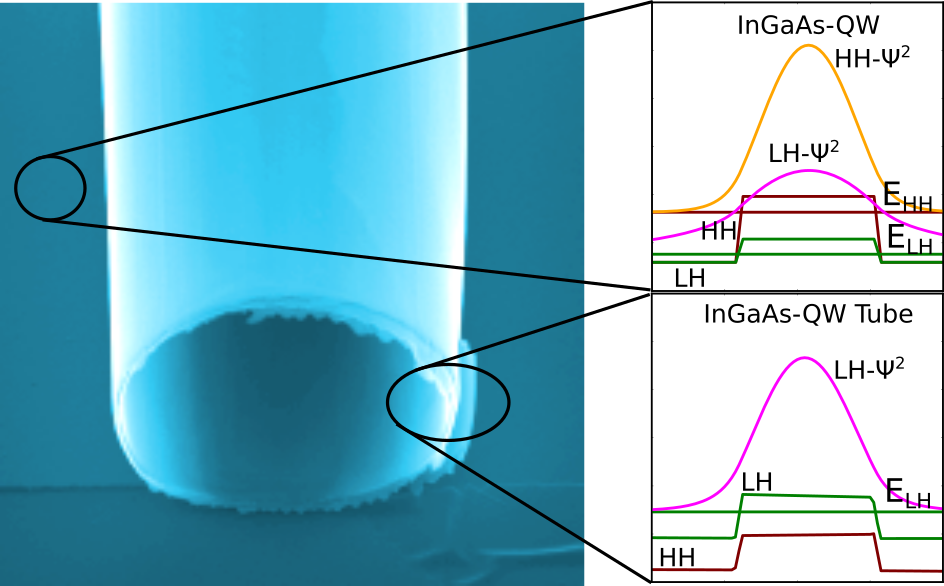
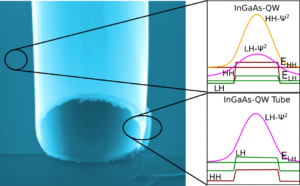 After seeing the effect the first time 10 years ago in old samples, we finally figured out what was happening. See out latest results in ACS Appl. Nano Mater. with the title “Rolled-Up Quantum Wells Composed of Nanolayered InGaAs/GaAs Heterostructures as Optical Materials for Quantum Information Technology”: