Recent Research Projects as Principal Investigator

Nov 14, 2024 – Dec 31, 2025, CAPES: Call No. 07/2024 – Magnetic Systems for Bioremediation. Move la America
The general objective of the work plan is to design and characterize magnetic microcapsules as vehicles for cyanobacteria. It aims to assess the viability of cyanobacteria and the potential use of materials for removing specific contaminants from water. To achieve this, the following specific objectives will be pursued:

Jul 1, 2023 – Jun 30, 2025, FAPESP – Regular Grant: Ferrofluids for Viscous Fluid Flow Applications.
This project seeks to enhance the magnetic properties of ferrofluids to optimize the conversion of electromagnetic energy into heat via the magneto-hyperthermia (MH) effect, for application in the recovery and transport of oil or any viscous fluid by reducing its viscosity. MH is a phenomenon in which the temperature of a system containing magnetic nanoparticles (NPs) increases when exposed to an alternating magnetic field, as the electromagnetic energy is converted into heat through the magnetization reversal of the NPs. Viscosity, on the other hand, decreases as temperature rises. Highly viscous liquids are present in several industries, including Oil & Gas, pharmaceuticals, chemical, and food sectors, where reducing viscosity can lead to lower extraction or transportation costs. The potential implementation of magnetic nanoparticles in this technological challenge originates from a fundamental issue related to the dispersion of NPs in viscous fluids. Therefore, this project aims to develop new synthesis methods for colloidal magnetic nanoparticle systems, targeting their implementation in fluid extraction or transport technologies.

Mar 1, 2024 – Feb 28, 2027, CNPq – Magneto-hyperthermia in Clustered Nanoparticles.
Productivity in Research Grant, PQ2.
This project is of significant scientific and technological relevance. From a technological perspective, it could lead to the development of new technologies that reduce costs in processes involving the transport of viscous liquids, with potential applications across a broad range of industries. Additionally, magnetic nanoparticles can be easily recovered and reused. From a scientific standpoint, the project will contribute to the generation of knowledge in the field of colloidal NP dispersions—a cross-cutting topic relevant to any colloidal NP system, magnetic or non-magnetic.
There is no consensus in the international scientific community regarding the effects of dipolar interactions between magnetic nanoparticles and their consequences on heat capacity. This project will also contribute to the training of new researchers, with a minimum of three undergraduate students and one master’s student involved, in addition to a postdoctoral researcher contributing to various activities.
Visite our Group

Logotype by Maria Eugenia Fortes Brollo
| Year | Project Title | Agency/Grant number# |
| 2019-2021 | Studies of Fe3-xCoxO4 composite magnetic nanoparticles: Fundamentals of magnetism and applications | MCTIC/CNPq Nº 28/2018 – Universal/Faixa B, # 425501/2018-3 |
| 2017-2020 | Studies of complex magnetic nanoparticles and nanoparticle arrays for magnetic devices | CNPq Nº 12/2017 – PD, 700.899.371-47, # 303236/2017-5 |
Concluded Projects:
Interface effects on complex magnetic nanoparticles of dumbbell, flower and dimers shape like.
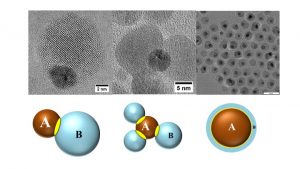
In collaboration with: Oscar Moscoso Londoño (IFGW/Unicamp/Brasil), Latif U. Khan (LNNano/CNPEM/Brasil), Surender Kumar Sharma (UFMA/Brasil), Luelc Souza (LNNano/CNPEM)
Related Articles
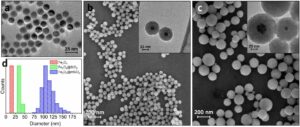
- Compact Ag@Fe3O4 Core-shell Nanoparticles by Means of Single-step Thermal Decomposition Reaction. https://www.nature.com/articles/srep06839
- Physicochemical Studies of Complex SilverMagnetite Nanoheterodimers with Controlled Morphology .http://pubs.acs.org/doi/abs/10.1021/jp501453m
- Surface and interface interplay on the oxidizing temperature of iron oxide and Au–iron oxide core–shell nanoparticles.http://pubs.rsc.org/en/Content/ArticleLanding/2016/RA/C6RA15610J#!divAbstract
- Optical and magnetic nanocomposites containing Fe3O4@SiO2 grafted with Eu3+ and Tb3+ complexes.http://www.sciencedirect.com/science/article/pii/S0925838816317200?via%3Dihub
- Red-Green Emitting and Superparamagnetic Nanomarkers Containing Fe3O4 Functionalized with Calixarene and Rare Earth Complexes. http://pubs.acs.org/doi/abs/10.1021/ic5018856
Dipolar interaction effects on diluted and concentrated systems with superparamagnetic nanoparticles for magneto hyperthermia applications
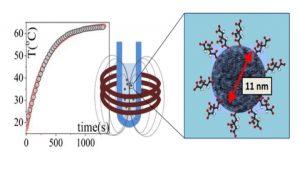
In collaboration with: Pedro Mendoza Zélis (IFLP/UNLP/Argentina), Oscar Moscoso Londoño (IFGW/Unicamp/Brasil), Marcela B. Fernández van Raap (IFLP/UNLP/Argentina).
Related Articles
- Effects of Nanostructure and Dipolar Interactions on Magnetohyperthermia in Iron Oxide Nanoparticles. http://pubs.acs.org/doi/abs/10.1021/acs.jpcc.6b00900
- Different approaches to analyze the dipolar interaction effects on diluted and concentrated granular superparamagnetic systems. http://www.sciencedirect.com/science/article/pii/S0304885316317528?via%3Dihub
- Stress-Induced Gene Expression Sensing Intracellular Heating Triggered by Magnetic Hyperthermia. http://pubs.acs.org/doi/abs/10.1021/jp311556b
- Magnetic hyperthermia in brick-like Ag@Fe3O4 core-shell nanoparticles. http://www.sciencedirect.com/science/article/pii/S0304885315305072?via%3Dihub
- Quasi-static magnetic measurements to predict specific absorption rates in magnetic fluid hyperthermia experiments. http://aip.scitation.org/doi/10.1063/1.4862647
Magnetic properties of polymeric films with shape memory for medical application.
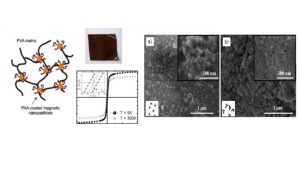
In collaboration with: M. A. Mosiewicki and C. Meiorin (INTEMA/UNMdP/Argentina)
Related Articles
- Magnetic composite films based on alginate and nano-iron oxide particles obtained by synthesis “in situ”. http://www.sciencedirect.com/science/article/pii/S0014305717305943?via%3Dihub
- Magnetism and structure of nanocomposites made from magnetite and vegetable oil based polymeric matrices.http://www.sciencedirect.com/science/article/pii/S0014305717305943?via%3Dihub
- Magnetic characterization of chitosan–magnetite nanocomposite films.http://www.sciencedirect.com/science/article/pii/S0014305715004802?via%3Dihub