
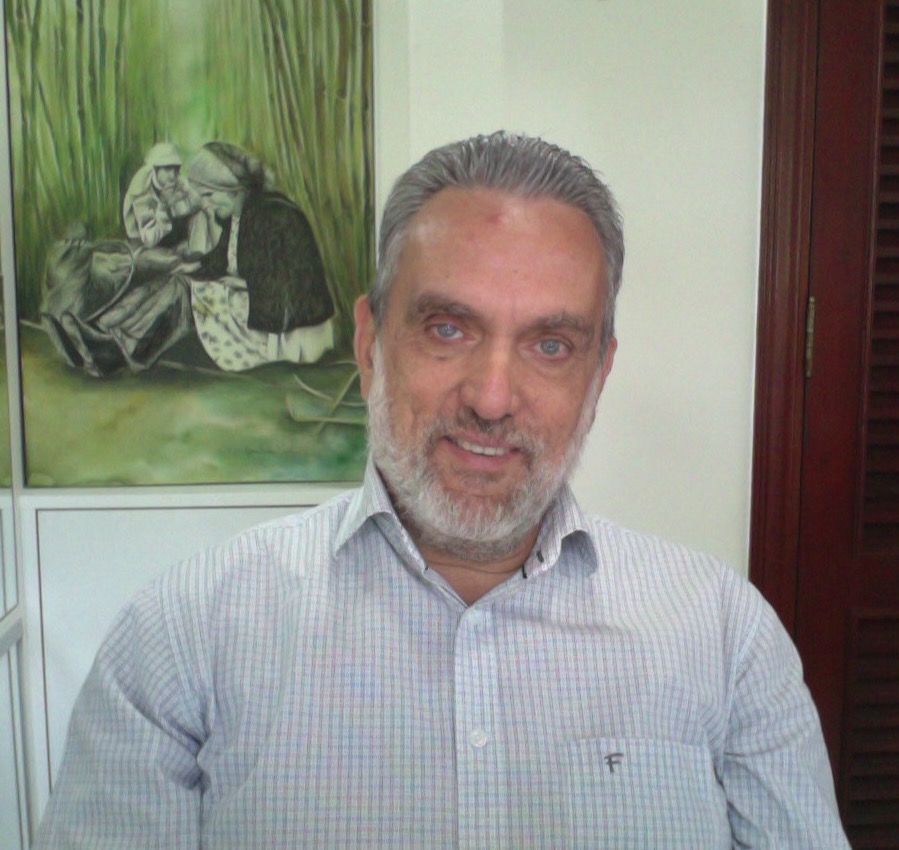
🌍Born in São Paulo, Brazil, in 1957, he grew up in Caieiras, a small city near São Paulo, where he completed most of his education in public institutions. He earned his undergraduate and master’s degrees in Physics from the University of São Paulo (USP) and obtained his Ph.D. in Chemistry from the California Institute of Technology (Caltech), Pasadena, USA, between 1981 and 1986.
📚Before joining the University of Campinas (Unicamp) in 1987, he worked at the Institute for Advanced Studies (IEAv) of the Aerospace Technical Center (CTA), in São José dos Campos. He has been a Full Professor at the Gleb Wataghin Institute of Physics (IFGW–Unicamp) since 1998.
Academic Career and Research
📚He is a theoretical physicist with expertise in Atomic and Molecular Physics, particularly in low-energy electron and positron scattering by molecules. Over the course of his career, he has published more than 180 papers in indexed scientific journals, accumulating over 4,000 citations according to Web of Science. He has supervised 17 Ph.D. theses and served as an editor of The European Physical Journal D from 2004 to 2012.
📚He has delivered numerous invited lectures at international conferences and institutions across the United States, Europe, Asia, and Latin America. He was a CNPq Research Fellow at the highest level (1A) from 2004 to 2021 and has acted extensively as a referee and advisor for international journals and research funding agencies, including FAPESP and CNPq.
Scientific Leadership and Service
🌐He has played a significant role in the international Atomic and Molecular Physics community, serving on the General Committee and as Vice-Chair of the 2005 ICPEAC Conference (Buenos Aires), as well as on its Executive Committee from 2005 to 2009. In 2005, the World Year of Physics, he organized two ICPEAC satellite conferences in Brazil, which later evolved into the permanent joint meeting known as POSMOL.
🏛️At Unicamp, he has held several leadership and administrative positions, including member of the University Council, Undergraduate Program Coordinator, Head of the Department of Quantum Electronics, and evaluator for the Brazilian Ministry of Education. He also served as Treasurer of the Brazilian Physical Society.
National Projects and Strategic Initiatives
🌱Between 2008 and 2012, he was the founding Director of the Brazilian Bioethanol Science and Technology National Laboratory (CTBE/CNPEM), now the National Laboratory of Biorenewables (LNBR), where he led its implementation and early scientific strategy.
🏛️From 2017 to 2021, he served as Executive Director for Integrated Planning at Unicamp (DEPI), during the presidency of Prof. Marcelo Knobel. In this role, he coordinated the creation of the International Hub for Sustainable Development (HIDS), a large-scale, interdisciplinary initiative aimed at connecting science, technology, policy, and society around sustainability challenges.
🏅He received the Zeferino Vaz Academic Recognition Award twice (2001 and 2013) and was elected a full member of the São Paulo State Academy of Sciences in 2015.
Current Activities and Vision
🌱After retiring from his tenured position in 2022, he began articulating, in partnership with PUC-Campinas and multiple national stakeholders, the creation of the National Laboratory for Sustainable Development (LANDS). This initiative has received institutional and political support and has been formally presented to the Vice-President of Brazil, reflecting a broader vision of sustainability as a long-term State project.
🌱In 2026, he returned to the Institute of Physics (IFGW) as a voluntary collaborator and is currently structuring the creation of the Laboratory for Sustainable Development (LDS) — an institutional initiative at Unicamp designed to foster interdisciplinary collaboration and societal engagement around sustainability.
🪞In parallel, he is preparing a new and experimental version of the graduate course F689 — Quantum Mechanics, integrating intensive and critical use of Artificial Intelligence. Quantum Mechanics has profoundly shaped science and technology throughout the 20th and 21st centuries; Artificial Intelligence, itself a product of this scientific revolution, is now transforming education, research, and society. Teaching and learning Quantum Mechanics in dialogue with AI is, in his view, one of the most stimulating intellectual and pedagogical challenges of our time.


Recent Comments