
de Sousa, JM; Aguiar, AL; Girao, EC; Fonseca, Alexandre F; AG Filho, Souza; Galvao, Douglas S
Mechanical Properties and Fracture Patterns of Pentagraphene Membranes (under review) Journal Article
In: 2019.
@article{deSousa2019,

title = {Mechanical Properties and Fracture Patterns of Pentagraphene Membranes (under review)},

author = {de Sousa, JM and Aguiar, AL and Girao, EC and Fonseca, Alexandre F and AG Filho, Souza and Galvao, Douglas S},

year  = {2019},

date = {2019-01-05},

keywords = {},

pubstate = {published},

tppubtype = {article}

}
Lima, Marcio D; Li, Na; De Andrade, Monica Jung; Fang, Shaoli; Oh, Jiyoung; Spinks, Geoffrey M; Kozlov, Mikhail E; Haines, Carter S; Suh, Dongseok; Foroughi, Javad; Kim, Seon Jeong; Chen, Yongsheng; Ware, Taylor; Shin, Min Kyoon; Machado, Leonardo D; Fonseca, Alexandre F; Madden, John DW; Voit, Walter E; Galvao, Douglas S; Baughman, Ray H
Electrically, chemically, and photonically powered torsional and tensile actuation of hybrid carbon nanotube yarn muscles Journal Article
In: Science, vol. 338, no. 6109, pp. 928–932, 2012.
@article{lima2012electrically,

title = {Electrically, chemically, and photonically powered torsional and tensile actuation of hybrid carbon nanotube yarn muscles},

author = {Lima, Marcio D and Li, Na and De Andrade, Monica Jung and Fang, Shaoli and Oh, Jiyoung and Spinks, Geoffrey M and Kozlov, Mikhail E and Haines, Carter S and Suh, Dongseok and Foroughi, Javad and Kim, Seon Jeong and Chen, Yongsheng and Ware, Taylor and Shin, Min Kyoon and Machado, Leonardo D and Fonseca, Alexandre F and Madden, John DW and Voit, Walter E and Galvao, Douglas S and Baughman, Ray H

},

url = {http://www.sciencemag.org/content/338/6109/928.short},

year  = {2012},

date = {2012-01-01},

journal = {Science},

volume = {338},

number = {6109},

pages = {928--932},

publisher = {American Association for the Advancement of Science},

abstract = {Artificial muscles are of practical interest, but few types have been commercially exploited. Typical problems include slow response, low strain and force generation, short cycle life, use of electrolytes, and low energy efficiency. We have designed guest-filled, twist-spun carbon nanotube yarns as electrolyte-free muscles that provide fast, high-force, large-stroke torsional and tensile actuation. More than a million torsional and tensile actuation cycles are demonstrated, wherein a muscle spins a rotor at an average 11,500 revolutions/minute or delivers 3% tensile contraction at 1200 cycles/minute. Electrical, chemical, or photonic excitation of hybrid yarns changes guest dimensions and generates torsional rotation and contraction of the yarn host. Demonstrations include torsional motors, contractile muscles, and sensors that capture the energy of the sensing process to mechanically actuate.},

keywords = {},

pubstate = {published},

tppubtype = {article}

}
Coluci, Vitor R; Fonseca, Alexandre F; Galvao, Douglas S; Daraio, Chiara
Entanglement and the nonlinear elastic behavior of forests of coiled carbon nanotubes Journal Article
In: Physical Review Letters, vol. 100, no. 8, pp. 086807, 2008.
@article{coluci2008entanglement,

title = {Entanglement and the nonlinear elastic behavior of forests of coiled carbon nanotubes},

author = {Coluci, Vitor R and Fonseca, Alexandre F and Galvao, Douglas S and Daraio, Chiara},

url = {http://journals.aps.org/prl/abstract/10.1103/PhysRevLett.100.086807},

year  = {2008},

date = {2008-01-01},

journal = {Physical Review Letters},

volume = {100},

number = {8},

pages = {086807},

publisher = {American Physical Society},

abstract = {Helical or coiled nanostructures have been objects of intense experimental and theoretical studies due to their special electronic and mechanical properties. Recently, it was experimentally reported that the dynamical response of a foamlike forest of coiled carbon nanotubes under mechanical impact exhibits a nonlinear, non-Hertzian behavior, with no trace of plastic deformation. The physical origin of this unusual behavior is not yet fully understood. In this Letter, based on analytical models, we show that the entanglement among neighboring coils in the superior part of the forest surface must be taken into account for a full description of the strongly nonlinear behavior of the impact response of a drop ball onto a forest of coiled carbon nanotubes.},

keywords = {},

pubstate = {published},

tppubtype = {article}

}
Fonseca, Alexandre F; Malta, CP; Galvao, DS
Is it possible to grow amorphous normal nanosprings? Journal Article
In: Nanotechnology, vol. 18, no. 43, pp. 435606, 2007.
@article{fonseca2007possible,

title = {Is it possible to grow amorphous normal nanosprings?},

author = {Fonseca, Alexandre F and Malta, CP and Galvao, DS},

url = {http://iopscience.iop.org/0957-4484/18/43/435606},

year  = {2007},

date = {2007-01-01},

journal = {Nanotechnology},

volume = {18},

number = {43},

pages = {435606},

publisher = {IOP Publishing},

abstract = {Nanosprings have been objects of intense investigations in recent years. They can be classified as normal or binormal depending on the geometry of their cross-section. As normal amorphous nanosprings have not yet been observed experimentally, we have decided to investigate this matter. We discuss the shape of the catalyst in terms of the cross-sectional shape of the nanospring and show that, within the vapor–liquid–solid model, the growth of amorphous binormal nanosprings is energetically favored.},

keywords = {},

pubstate = {published},

tppubtype = {article}

}
2019
de Sousa, JM; Aguiar, AL; Girao, EC; Fonseca, Alexandre F; AG Filho, Souza; Galvao, Douglas S
Mechanical Properties and Fracture Patterns of Pentagraphene Membranes (under review) Journal Article
In: 2019.
BibTeX | Tags: Fracture, Molecular Dynamics, pentagraphene
@article{deSousa2019,

title = {Mechanical Properties and Fracture Patterns of Pentagraphene Membranes (under review)},

author = {de Sousa, JM and Aguiar, AL and Girao, EC and Fonseca, Alexandre F and AG Filho, Souza and Galvao, Douglas S},

year  = {2019},

date = {2019-01-05},

keywords = {Fracture, Molecular Dynamics, pentagraphene},

pubstate = {published},

tppubtype = {article}

}
2012

Lima, Marcio D; Li, Na; De Andrade, Monica Jung; Fang, Shaoli; Oh, Jiyoung; Spinks, Geoffrey M; Kozlov, Mikhail E; Haines, Carter S; Suh, Dongseok; Foroughi, Javad; Kim, Seon Jeong; Chen, Yongsheng; Ware, Taylor; Shin, Min Kyoon; Machado, Leonardo D; Fonseca, Alexandre F; Madden, John DW; Voit, Walter E; Galvao, Douglas S; Baughman, Ray H
Electrically, chemically, and photonically powered torsional and tensile actuation of hybrid carbon nanotube yarn muscles Journal Article
In: Science, vol. 338, no. 6109, pp. 928–932, 2012.
Abstract | Links | BibTeX | Tags: Actuation, Artificial Muscles, Carbon Nanotubes, top20, Yarns
@article{lima2012electrically,

title = {Electrically, chemically, and photonically powered torsional and tensile actuation of hybrid carbon nanotube yarn muscles},

author = {Lima, Marcio D and Li, Na and De Andrade, Monica Jung and Fang, Shaoli and Oh, Jiyoung and Spinks, Geoffrey M and Kozlov, Mikhail E and Haines, Carter S and Suh, Dongseok and Foroughi, Javad and Kim, Seon Jeong and Chen, Yongsheng and Ware, Taylor and Shin, Min Kyoon and Machado, Leonardo D and Fonseca, Alexandre F and Madden, John DW and Voit, Walter E and Galvao, Douglas S and Baughman, Ray H

},

url = {http://www.sciencemag.org/content/338/6109/928.short},

year  = {2012},

date = {2012-01-01},

journal = {Science},

volume = {338},

number = {6109},

pages = {928--932},

publisher = {American Association for the Advancement of Science},

abstract = {Artificial muscles are of practical interest, but few types have been commercially exploited. Typical problems include slow response, low strain and force generation, short cycle life, use of electrolytes, and low energy efficiency. We have designed guest-filled, twist-spun carbon nanotube yarns as electrolyte-free muscles that provide fast, high-force, large-stroke torsional and tensile actuation. More than a million torsional and tensile actuation cycles are demonstrated, wherein a muscle spins a rotor at an average 11,500 revolutions/minute or delivers 3% tensile contraction at 1200 cycles/minute. Electrical, chemical, or photonic excitation of hybrid yarns changes guest dimensions and generates torsional rotation and contraction of the yarn host. Demonstrations include torsional motors, contractile muscles, and sensors that capture the energy of the sensing process to mechanically actuate.},

keywords = {Actuation, Artificial Muscles, Carbon Nanotubes, top20, Yarns},

pubstate = {published},

tppubtype = {article}

}
2008
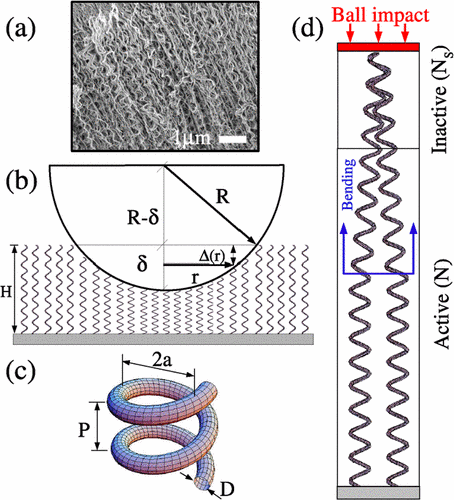
Coluci, Vitor R; Fonseca, Alexandre F; Galvao, Douglas S; Daraio, Chiara
Entanglement and the nonlinear elastic behavior of forests of coiled carbon nanotubes Journal Article
In: Physical Review Letters, vol. 100, no. 8, pp. 086807, 2008.
Abstract | Links | BibTeX | Tags: Carbon Nanotube Forests, Entanglement, Mechanical Properties, top20
@article{coluci2008entanglement,

title = {Entanglement and the nonlinear elastic behavior of forests of coiled carbon nanotubes},

author = {Coluci, Vitor R and Fonseca, Alexandre F and Galvao, Douglas S and Daraio, Chiara},

url = {http://journals.aps.org/prl/abstract/10.1103/PhysRevLett.100.086807},

year  = {2008},

date = {2008-01-01},

journal = {Physical Review Letters},

volume = {100},

number = {8},

pages = {086807},

publisher = {American Physical Society},

abstract = {Helical or coiled nanostructures have been objects of intense experimental and theoretical studies due to their special electronic and mechanical properties. Recently, it was experimentally reported that the dynamical response of a foamlike forest of coiled carbon nanotubes under mechanical impact exhibits a nonlinear, non-Hertzian behavior, with no trace of plastic deformation. The physical origin of this unusual behavior is not yet fully understood. In this Letter, based on analytical models, we show that the entanglement among neighboring coils in the superior part of the forest surface must be taken into account for a full description of the strongly nonlinear behavior of the impact response of a drop ball onto a forest of coiled carbon nanotubes.},

keywords = {Carbon Nanotube Forests, Entanglement, Mechanical Properties, top20},

pubstate = {published},

tppubtype = {article}

}
2007
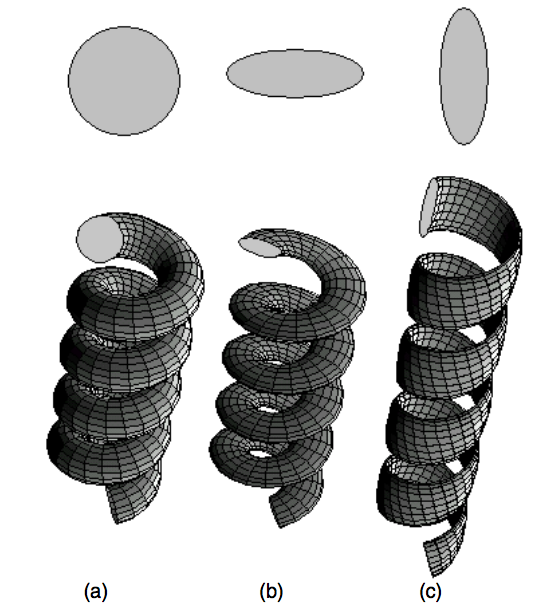
Fonseca, Alexandre F; Malta, CP; Galvao, DS
Is it possible to grow amorphous normal nanosprings? Journal Article
In: Nanotechnology, vol. 18, no. 43, pp. 435606, 2007.
Abstract | Links | BibTeX | Tags: Elasticity, Helical Structures, Mechanical Properties, Nanowires
@article{fonseca2007possible,

title = {Is it possible to grow amorphous normal nanosprings?},

author = {Fonseca, Alexandre F and Malta, CP and Galvao, DS},

url = {http://iopscience.iop.org/0957-4484/18/43/435606},

year  = {2007},

date = {2007-01-01},

journal = {Nanotechnology},

volume = {18},

number = {43},

pages = {435606},

publisher = {IOP Publishing},

abstract = {Nanosprings have been objects of intense investigations in recent years. They can be classified as normal or binormal depending on the geometry of their cross-section. As normal amorphous nanosprings have not yet been observed experimentally, we have decided to investigate this matter. We discuss the shape of the catalyst in terms of the cross-sectional shape of the nanospring and show that, within the vapor–liquid–solid model, the growth of amorphous binormal nanosprings is energetically favored.},

keywords = {Elasticity, Helical Structures, Mechanical Properties, Nanowires},

pubstate = {published},

tppubtype = {article}

}
http://scholar.google.com/citations?hl=en&user=95SvbM8AAAAJ

